Does Part-Time Pilot Training Cost More? 2026 Budget Math
Published by: Jordan Morris
Two working adults sign up for private pilot training in the same month, with the same published estimate in hand. One flies three times a week, before work and on Saturdays. The other flies every other Saturday, when the calendar allows. A year later, the first one has a certificate in their wallet. The second is still flying, still paying, and just renewed their renter’s insurance.
Training part time doesn’t have to cost more, but training infrequently usually does. The part time pilot training cost you end up paying comes down less to the price sheet and more to how often you fly. Long gaps turn into review time, review time turns into extra hours, and a plan that drags past a year picks up yearly costs on top. Below, we’ll show you the numbers behind each of those and how to build a monthly budget that keeps you flying steadily.
What Our Published Private Pilot Estimate Covers
At Speedway Flight Training, our published estimate for the Private Pilot program is $17,637.50, based on 50 hours of flight training and 18.5 hours of ground lessons, with additional expenses on top. Prices change, so give us a call at (678) 944-7379 and we’ll confirm current numbers before you start.
The FAA minimum is 40 hours of flight time for a private pilot certificate, and you can see the full experience requirements on the FAA’s page on hourly requirements for becoming a pilot. Most students need more than the minimum, which is why we plan around 50 hours instead of 40.
The estimate includes one-on-one instruction, pre- and post-flight ground time with your instructor, mock oral exams, ground school and exam prep, the Gleim Deluxe Private Pilot Kit, foggles, a fuel tester, and pre-checkride preparation. Here’s what sits outside it:
| Not included in the estimate | Approximate cost | How often you pay |
|---|---|---|
| Noise-canceling aviation headset | $600 to $1,200 | Once |
| iPad with GPS (cellular capable) | $500 to $700 | Once |
| Aircraft rental insurance | about $600 | Every year |
| ForeFlight subscription | about $250 | Every year |
| FAA written exam | about $175 | Each attempt |
| Examiner (DPE) practical exam fee | $800 to $1,200 | Each attempt |
| FAA first-class medical (for a professional pilot track) | about $150 | Per exam |
| Sales tax | Applicable rates | Per purchase |
Add up the approximate figures in that table and the extras come to roughly $3,075 to $4,275 before tax. Two more items belong in your plan. Program pricing may be subject to a fuel surcharge based on current fuel and oil prices, calculated on aircraft tach time and billed in addition to the published price. Training credits are also non-transferable to another person, program, package, or course unless we approve it in writing. You can browse headsets in our pilot store.
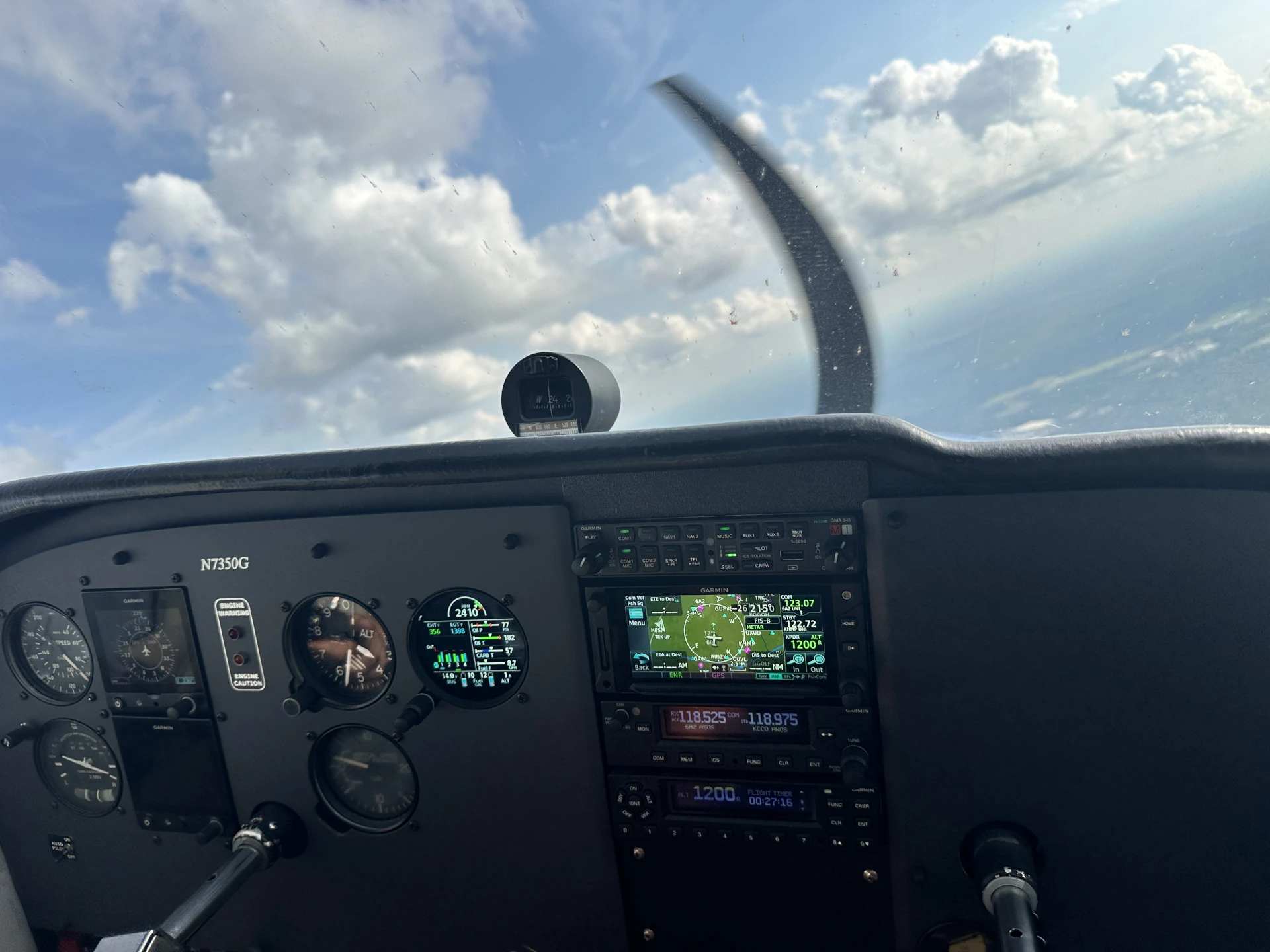
Every lesson you fly counts toward your total hours, so frequency shapes your budget.
How Long Gaps Between Lessons Turn Into Extra Hours
Flying is a physical skill, and it fades fast. When you fly two or three times a week, each lesson starts where the last one ended. After a two-week gap, the briefing turns into a recap, and the first twenty minutes in the air often go to getting your landing picture back.
That review time is billed time, and it doesn’t move you toward the checkride. To put a rough size on it, here’s some what-if math. We’re assuming about 34 lessons of 1.5 hours each to reach 50 hours (the same planning basis as our part-time training timeline), plus a guessed amount of review per lesson at each pace.
| Lessons a week | Assumed review per lesson | Review across about 34 lessons | Share of a 50-hour plan |
|---|---|---|---|
| 3 | about 5 minutes | about 3 hours | about 6% |
| 2 | about 10 minutes | about 6 hours | about 11% |
| 1 | about 20 minutes | about 11 hours | about 23% |
Treat this table as illustrative arithmetic built on our assumptions, not a measured result. Your own review time will be different, and some students need very little. The direction holds, though: the longer the gap, the more of each lesson goes backward, and every one of those hours is billed at current aircraft and instructor rates.
Sam B., one of our students, described the opposite experience in a review: “They don’t waste your time by stretching out lessons or adding unnecessary hours.” Steady scheduling is a big part of how that happens.
A steady pace keeps each flight building on the last one.
The Yearly Costs That Renew When Training Stretches Out
Two of the extras in the table are annual: renter’s insurance at about $600 a year and ForeFlight at about $250 a year. If you finish inside 12 months, you pay each once. If training stretches past a year, plan for about $850 more for a second year.
Here’s how a slow plan gets there. At one lesson a week, with about 11 hours of review added from the table above, you’re looking at roughly 41 to 42 lessons. If about one lesson in four gets cancelled for weather or work, that pace runs close to 55 weeks, which is past the one-year mark. This uses the same assumptions as the table, so treat it as a rough example too.
The FAA’s clocks add their own costs. Your knowledge test result has to fall within the 24 calendar months before the month you finish your checkride, so a plan that stalls badly can mean paying the written exam fee again. Solo endorsements are tied to training within the previous 90 days, so a long break can mean dual flights with your instructor before you solo again. Our post on staying proficient in the off-season has ways to keep skills warm.
Turn the Estimate Into a Monthly Budget You Can Keep
Most working adults don’t think in totals. They think in monthly payments. Here’s how much of the published estimate lands in each month at each pace, using the calendar math from our timeline post, before cancellations and extras.
| Lessons a week | Approximate training length | Estimate spread per month |
|---|---|---|
| 3 | about 3 months | about $5,880 |
| 2 | about 4 months | about $4,410 |
| 1 | about 8 months | about $2,205 |
These are illustrative numbers from stated assumptions, not a payment schedule. They show the trade-off clearly, though. Flying less often lowers what you spend each month, but it doesn’t lower the total, and the review hours and yearly renewals above tend to push the total up.
A better approach for most budgets is to spread the money, not the lessons. Pick a pace you can fund for the whole stretch, ideally the three lessons a week we recommend, and line up the funding before you start. If you can’t fly three times a week, two lessons plus a backup slot is a reasonable middle ground. Our post on evening flight lessons and a weekly plan for working adults shows how to build that week around a full-time job.
Plan the funding before you start so your pace can stay steady.
Ways to Pay Without Slowing Down
Running out of money halfway is an expensive way to train, because the break that follows brings back all the review costs above. That’s why financing belongs in your plan from day one.
We work with Stratus Financial, which pays the school directly as you train. Financing is available to qualified applicants and is subject to a credit check and underwriting. Initial underwriting usually takes 1 to 2 hours, and there’s no penalty for paying the loan off early. The application asks for recent paystubs and bank statements, employer contact details, and a 1st or 2nd class medical certificate, so book your medical exam early. Our FAA medical process guide walks through it, and you can start on our financing page.
If cost is the main thing keeping you on the ground, look at the Speedway Scholarship Fund. It supports students with financial need, and the award covers private pilot training from first ground lesson to checkride, not including retests. Details are on our scholarship page.
Frequently Asked Questions
Does part-time pilot training cost more than full-time training?
The published estimate is the same either way. What changes is how many hours you need. Long gaps between lessons add review time, and a plan that runs past a year adds a second year of insurance and ForeFlight. Part-time training at a steady pace keeps those extras small.
How much does a private pilot license cost at Speedway?
Our published estimate is $17,637.50, based on 50 flight hours and 18.5 ground hours, plus extras such as a headset, iPad, insurance, exam fees, and a possible fuel surcharge. The extras come to roughly $3,075 to $4,275 before tax. Contact us to confirm current pricing.
How much should I budget per month?
Divide your total budget by the months your pace will take. At three lessons a week, the estimate lands at about $5,880 a month over roughly three months. At one lesson a week, it drops to about $2,205 a month over roughly eight, but the total usually climbs.
Can I pause training and keep my credits?
Your credits stay yours, but they’re non-transferable to another person or program without our written approval. A long pause also means review flights when you return, so it’s usually cheaper to slow down than to stop.
Is financing available for part-time students?
Yes. Stratus Financial offers financing to qualified applicants, with funds paid directly to the school. Steady funding makes a steady pace easier to keep. Start on our financing page.
Why do you recommend three lessons a week if I’m on a budget?
Because frequency protects your budget. At three lessons a week, skills stay fresh, briefings build forward, and fewer paid minutes go to review. Our Private Pilot program is built around that rhythm.
Price Your Own Pace on a Discovery Flight
The best way to turn this math into your own number is to come fly with us. Book a discovery flight at Atlanta Speedway Airport (KHMP), tell us how many days a week you can train and what you can spend each month, and we’ll help you build a pace and a budget that fit your job. Book your discovery flight and start part-time training on a plan you can afford to finish.